


Everyone told us not to go.
Well not everyone. But nearly everyone. India in June? Why? There was record breaking heat. The inevitability of monsoons. Delhi belly. Pollution. Filth. But we were determined. We wanted a trip that pushed us. Something farther afield. A place neither of us had been. India.
The Beatles famously traveled to Rishikesh to study Transcendental Meditation and experienced massive creativity. Steve Jobs spent seven months at an ashram in Uttarakhand in 1974 in search of spirituality. Us? I think we just wanted to feel it. And we did. From the moment you arrive, India envelops you. In her heat, her scent, and her quiet but unmistakable wisdom. Even in June.
DELHI: A Bowl of Spoons
We arrived into Delhi via Paris at 2 a.m. and just dropped, sleeping well into the morning. But before even opening our eyes, we could hear that we were in India. The birds, bold and raucous, were not at all what we were used to hearing in Manchester. These were Indian house crows, black drongos, plum headed parakeets, laughing doves, and, yes—peacocks!
We dressed quickly and, a little bleary eyed, stepped out into the heat and color and mayhem and cacophony that is — Delhi. India is approximately one third the size of the US with roughly four times as many people, and it feels like it. With zero traffic lights, people on all manner of bikes, rickshaws, mopeds and tuk tuks are happily beeping their way along with an ability to fit in between each other that seems totally impossible. Every space is taken. You are passed with only a half an inch between you. Not to mention the dogs, goats, sauntering cows, and occasional monkeys who are also using these streets. It’s an organized madness that is inconceivable, at once terrifying and mesmerizing.
We had slept through breakfast at the hotel and so decided to take a car to the Imperial Hotel where we knew we could have a lovely meal and not suffer for it. Managing a trip to India without getting the dreaded Delhi belly is quite an undertaking, one we had made a pact to take seriously. Here we enjoyed richly spiced shahi paneer, biryani with its floral basmati, dried fruits, and herbed yogurt, and kulfi, a nutty spiced custard made by angels.
We had decided to spend the day exploring Old Delhi, all we needed was a driver. Stepping out into the street, we were immediately approached by an enthusiastic throng of candidates but one, a lovely older gentleman with a kind face and a Sikh’s turban, quietly came to our side. And so it was that Mr. Singh came to be our driver for the day. We walked just a few paces to his tuk tuk. Tuk tuks are the most marvelous modes of transport. A carriage built around a moped with all manner of colorful decorations and jingling sounds -- a moving party of sorts. You are at once exposed to the exhilarating experience of Indian traffic and yet are able to retreat back into the covered seats when you wish. I became very fond of tuk tuks — and Mr. Singh as well.
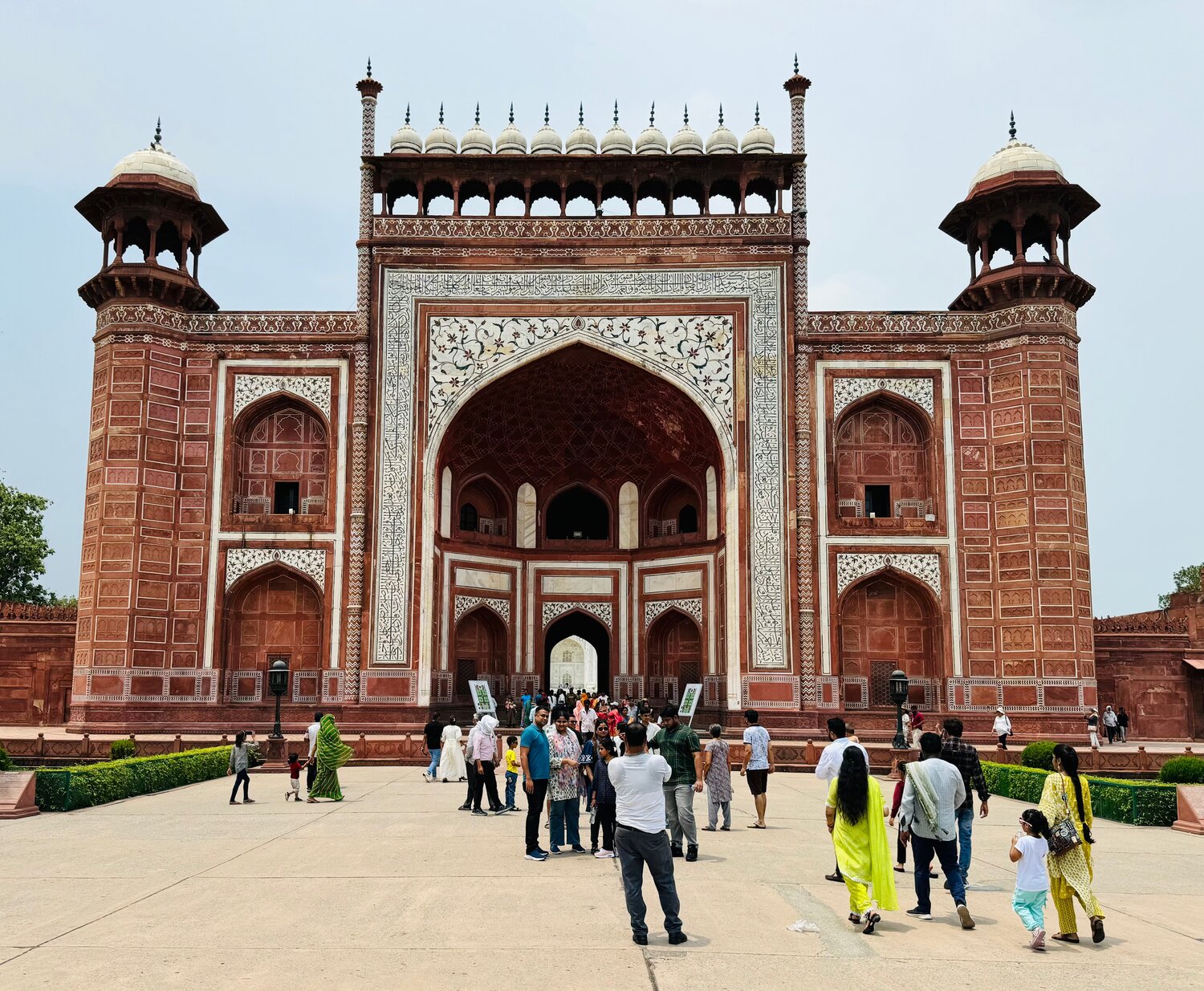
Mr. Singh took us to India Gate, an impressive war memorial near the eastern edge of the city. He then lined up a rickshaw to pedal us around the perimeter of the Red Fort, a breathtaking example of Mughal architecture (an Indo-Islamic architecture from the 16th, 17th, and 18th centuries) which spans 1.5 miles surrounding 255 acres. We rejoined the jolly tuk tuk to head to the spice market, rich and vibrant en route to Jama Masjid. Jama Masjid is one of India’s largest mosques. Made of red sandstone and white marble, it has three gateways, four angled towers, and two 40-meter-high minarets that, if you are up for it, you can climb to the top of, which we did in our bare feet. Here we found breathtaking views of Old Delhi and a bit of welcome solitude. We sat for a bit, taking in the sight of people praying, as they had been since the mosque’s completion in 1658. But looking beyond, we began to feel the ancient pull of India, 5000 years old. Thus far we had definitely heard India and started to see her, but now we were beginning, just a bit, to feel her.
Descending from our solitary minaret and after six straight hours of site seeing, we found ourselves, hot, thirsty, hungry, and with feet so dirty we dared not look. We agreed that heading back to the hotel for a long shower and a big lovely dinner was in order; Mr. Singh had other plans.
Would we be willing to visit his Sikh temple? He attended daily and it would mean a lot to him. We were honored. Falling in with hundreds of attending Sikhs we took off our shoes and covered our heads. Mr. Singh quietly explained the sweets on a leaf we were given as an offering, why he had never cut his hair or his beard, why he always had his kirpan, or sword, under his clothing, and other symbols of his faith. We met his daughter and his granddaughters. People sang and prayed, as my partner and I quietly stole glances at one other to say - how incredibly special to be inside this place, where we never would have been allowed otherwise, to witness this community. It was beautiful. Mr. Singh then took us to a large open room. People were sweeping the floor and unrolling long wool runners in rows. We followed Mr. Singh to the rear as people began entering the room and sitting cross legged on either side of the runners. Hundreds of people.
Mr. Sikh gave my partner a huge stack of metal trays and me a massive bowl filled with spoons. Then he pointed to the people on the floor. We were to pass them out. As I approached with my spoons each person cupped their hands to receive one. Most looked up, some did not. I smiled each time and was pleased to see smiles spread across their faces after the initial shock of seeing an American standing before them. Every spoon was a moment. And, for me, a gift.
What we would learn is that this happens in Sikh temples everywhere. Our trays and spoons were followed by lentils, potatoes, and bread. They feed all who come. Sikh or not. Every day.
AGRA: A Floating Love Story
Okay. Full disclosure, we nearly skipped Agra. Our itinerary was tight, Indian friends had told us we were trying to do too much and we had quietly wondered if the Taj Mahal was a bit over overblown.
It wasn’t.
It is totally different in person. Larger. Much much larger than one would imagine. With far more color. And furthermore, because of it’s position on a hill, it looks as though it is floating in midair. It is extraordinary. A mausoleum built for an emperor’s beloved wife, made entirely of white marble inlaid with lapis, coral, jade, turquoise, and onyx cut with exacting precision to form impossibly delicate patterns. It is a masterpiece. Breathtaking. And heartbreaking.
On our drive back to Delhi, we dozed with the windows down, watching fields pass. It was getting dark and we were hungry. We decided to try a restaurant recommended by an Indian friend in Boston -- Karim’s. We arrived in Delhi at nearly 9 p.m. Finding it took us down dark bustling alleyways with string lights and stalls selling all manner of things: sandals, jewelry, flowers, spices, everything. We noticed that women wore hijabs and men wore abayas. Prior to this we had been in Hindu
sections of Delhi and now we were clearly in a Muslim neighborhood.
We wound through alley after alley and finally there it was, Karim’s. Our driver wanted to wait for us. We tried to say no, but he felt responsible for us. So, we gave in, but insisted that he join us for dinner. The space was small and dark. Authentic. Over gorgeous food we shared pictures of our kids and stories of our lives. It was perfect.
We wove back through the night market, sultry and exotic, to the car. Returning to the hotel, our minds spinning, we went straight to bed as the next morning we were on an early flight to the Pink City of Jaipur for what would prove to be the most enchanting part of our journey.
Kris McGinn is the features editor at The Cricket. To read Part II of her story on India, CLICK HERE.


Comments
No comments on this item Please log in to comment by clicking here