




Passing the exit for John Wayne’s birthplace, the Ford V10 climbed Iowa’s rolling hills and rumbled down US80, bikes rack-mounted, trailer packed with bins, camping chairs, and coolers. The radio was on, but inaudible.
Our group of 12 was on route from Des Moines to the starting point of the world’s longest, oldest, and largest organized bicycle ride.
Hitting the Road
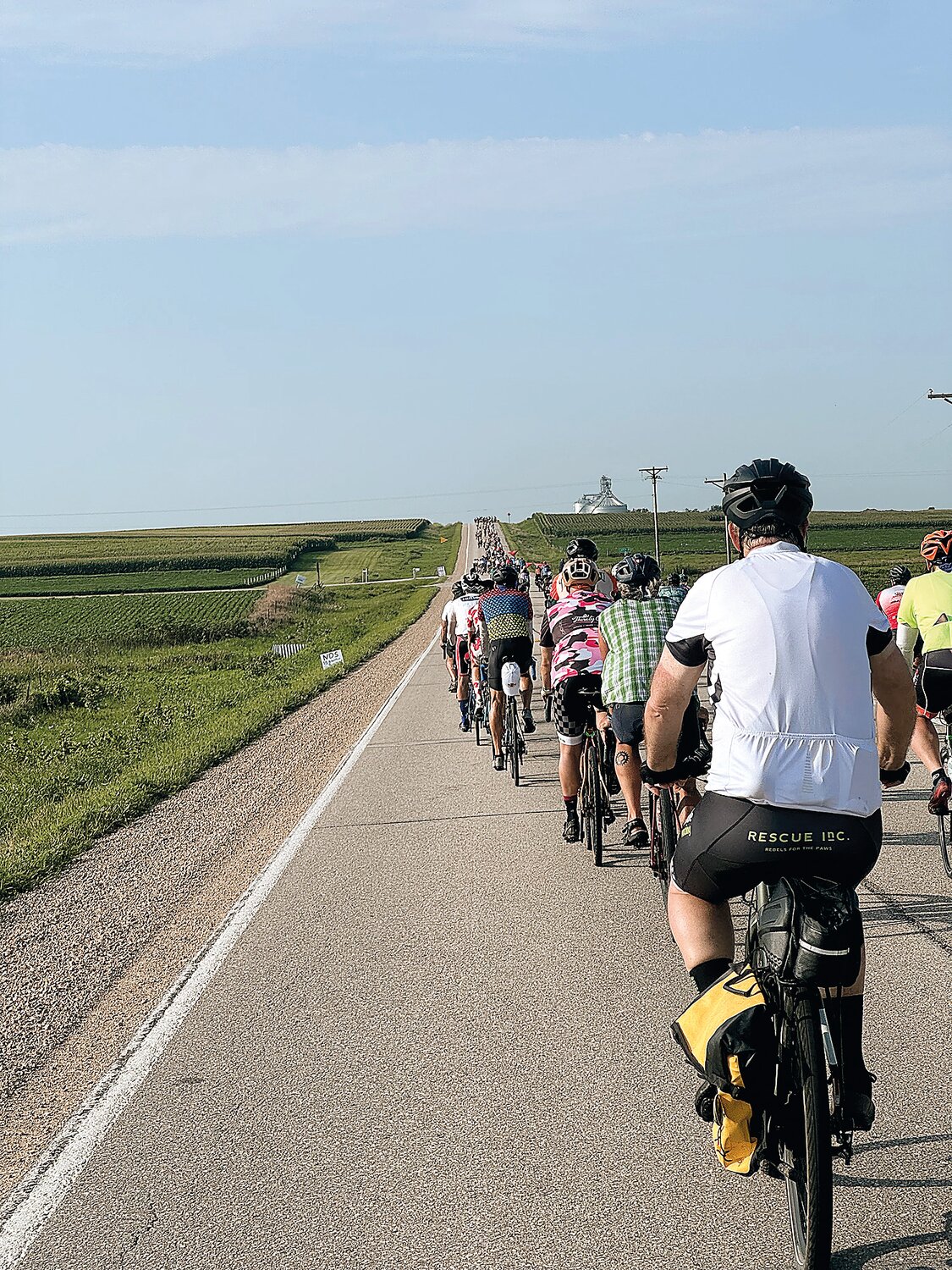
RAGBRAI, the “Register’s Annual Great Bicycle Ride Across Iowa,” began in 1973 when two Des Moine Register newspaper reporters chronicled a ride across Iowa. Their articles sparked so much interest that the inaugural ride of 200 cyclists would grow to an estimated 25,000 cyclists for this year’s 52nd rendition.
The 2025 ride began in Orange City, a Dutch town with miniature windmills and a dike system in the central park. The national anthem was sung by a choir, followed by ceremonial artillery blasts from the Iowa National Guard.
We camped beneath big shade trees next to three horses in an electric-fenced corral. Before dawn, the ride began—a steady flow of cyclists setting out on Day One’s 73-mile stretch to Milford.
Each night, local residents hosted us, offering grassy yards and access to bathrooms and showers. In Milford, our first overnight town, we lucked out—twelve beds in a million-dollar lakefront home with white linens and Ralph Lauren blankets.
Day Two ended in Estherville, home to a beautiful library with a photo of town namesake Esther Ridley and a sliver of the 1879 meteorite that hit nearby. We camped behind a 150-year-old house with a manicured lawn and flowers. The hosts, married 53 years, welcomed us warmly. Denny, the husband, shared stories from his post-retirement job working at the local cemetery—a role our group’s Jewish rider described as chesed shel emet, or “true kindness.”
Riding Together: A Family Journey
RAGBRAI has been called a church picnic, a traveling circus, and a bike ride. For us—a father and son—it was an extraordinary, shared experience. The father, now 64, was able to relive his 1981 bicycle journey from Colorado to California. As a bonus, our Croatian-born cousin\uncle, an elite cyclist, joined us and leaned into the fun-focused, non-competitive spirit of the week. Together, we enjoyed seven days of uninterrupted time and conversation—no screens, no Zoom meetings, no distractions.
On Day Three, we pedaled through Armstrong, Bancroft, Titonka, Woden, and Crystal Lake—tiny towns of a few hundred people. Each welcomed us with smiles, lemonade stands, and water hose showers. Many businesses made more money on this day than the rest of the year combined. Towns raised funds for youth trips, fire department
equipment, and American Legion building repairs. Volunteers were everywhere. The community pride was palpable.
In Forest City, we stayed with Linda, who had moved there just five months prior. A retired police officer and teacher, she signed up to host cyclists at her first town meeting. She radiated warmth and embraced the community spirit of the ride.
On Day Four, we arrived in Iowa Falls. The weather forecast was a 50% chance of storms. Around midnight, fierce winds hit and lightning cracked. The tarp ripped off and torrential rain collapsed our tent. After a soggy struggle, we gave up and sprinted in our underwear to a nearby garage. We salvaged two dry blankets and inflatable mattresses, laughed at the chaos, and fell asleep warm and dry.
Day Five began with Casey’s breakfast pizza and coffee. Food was plentiful on the route: sweet corn, pork chops, steak sandwiches, ice cream, and rhubarb pie. Local favorites included beef sundaes (mashed potatoes, beef, gravy), cheese curds, and walking tacos (Doritos bags filled with taco fixings).
The U.S. Air Force Cycling Team—over 100 riders strong—wore matching kits and served as guardian angels. If someone had a flat or was struggling, they’d surround and help them. They’re funded not by the government, but by donations to their nonprofit.
Another highlight: the Dream Team, a group of at-risk youth supported by mentors. Each rider trained for months and received a bike, jersey, helmet, and encouragement all the way. If they finished, they kept the gear—and the pride of accomplishment.
The Spirit of RAGBRAI
The original 1973 articles featured all kinds of riders: “old and young, thin and fat, fit and flabby.” One was Clarence Pickard, an 83-year-old who bought a bike the day before the ride and trained for “about half a block.” That spirit lives on. We saw George Gibbons, 93, doing his first RAGBRAI on a motorized trike, grinning ear to ear. One cyclist completed his fifth RAGBRAI with Bebe, his white winged parakeet, perched proudly on his shoulder the entire way.
Day Seven brought the “Swiss Alps of Iowa.” It’s a myth that Iowa is flat—we climbed 2,500 feet, more than a Pan-Mass Challenge Day. We saw tandems, unicycles, trikes, recumbents, ellipticals, even a penny-farthing. Around 10-15% of bikes were e-bikes. In Guttenberg, we dipped our tires in the Mississippi River, marking the ride’s end.
Cornfields, water towers, cheerful townspeople, and the camaraderie of 25,000 riders made this journey unforgettable.
For this father-son duo, the 406 miles from Orange City to Guttenberg were more than a ride—they were a lifelong memory.
Hunter Swanson and Don Swanson are summertime residents of Manchester. Inspired by the writings of I.M. Marshall, The Cricket’s first editor, “Postcards Home” is a travel feature written by local residents. Have you taken a trip you’d like to share with readers? Email us at news@thecricket.com.


Comments
No comments on this item Please log in to comment by clicking here